
Skip to content
The 51st State
ES / EN
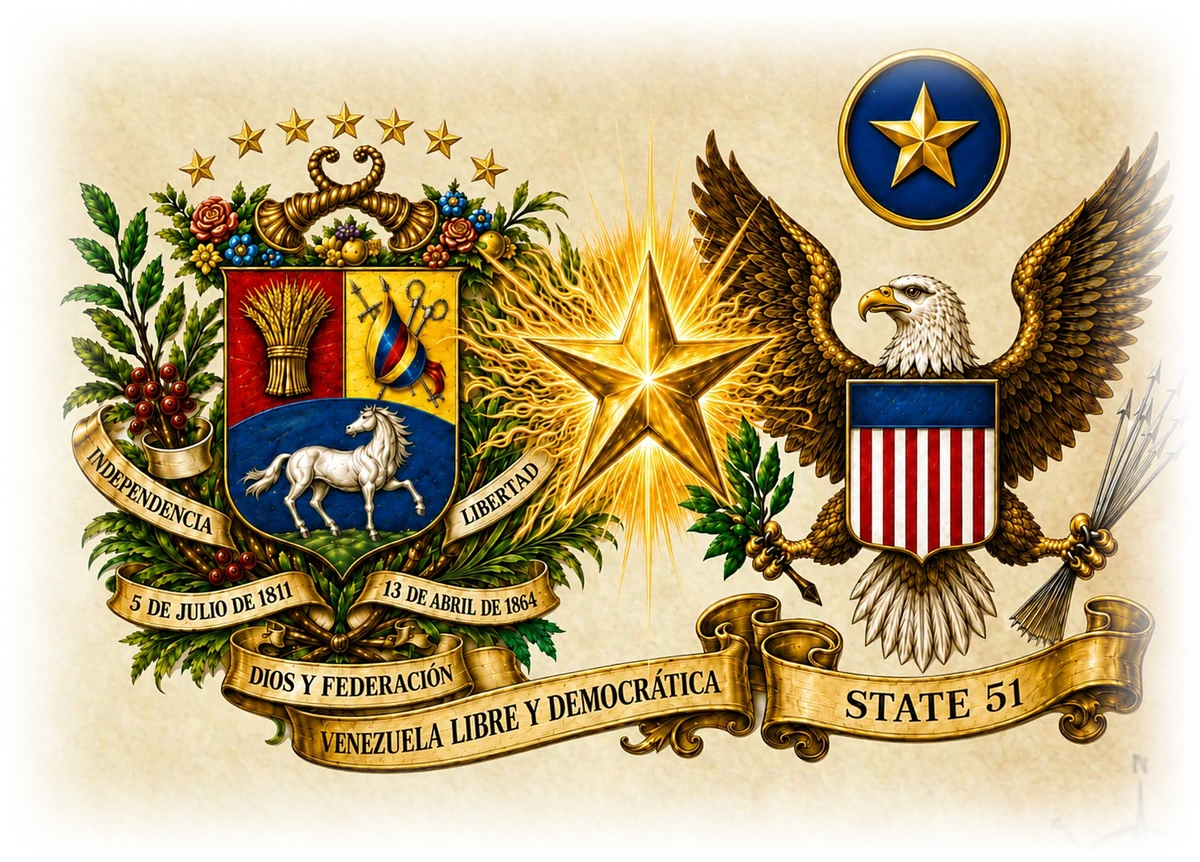
Emblem of The 51st State: the coat of arms of the United States of Venezuela and the American eagle, joined by a star
Venezuela · United States · The decision

Should Venezuela consider statehood?

The three paths, the yardstick by which each one is judged, and the thresholds that would have to be met.

  1. IA Free and Democratic Venezuela
  2. IISupervised Territoriality
  3. IIIThe 51st State
Start here

What we know so far

Updated September 23, 2026
  1. On January 3, 2026, U.S. forces captured Nicolás Maduro, and Delcy Rodríguez became interim president.FOX 13 (archived copy) · La Nación (AFP) (archived copy)
  2. Since March 2026, Donald Trump has floated the idea of Venezuela as the 51st state several times: on Truth Social, on Fox News, and with maps posted in May and in August.Forbes (archived copy) · Infobae (archived copy)
  3. On May 11, 2026, Delcy Rodríguez rejected the idea: “That would never be contemplated.”La Nación (AFP) (archived copy)
  4. Under the U.S. Constitution, the power to admit new states belongs to Congress, which does so by passing a law by simple majority in both houses.Constitution, Art. IV, Sec. 3 (archived copy) · CRS R47747 (archived copy)
Read it in full →
01 · The proposal

Three paths on the table

That decision belongs to the people of Venezuela and to the United States Congress. What a book can do is see that it is made with the information on the table.

I

A Free and Democratic Venezuela


The country recovers its institutions and governs itself, with a strategic alliance with the United States but without ceding sovereignty. It is the first aspiration and the one with the greatest historical legitimacy; its risk is relapse, and that is why it is only worth having if it is born irreversible.
II

Supervised Territoriality


A structural association of transition that provides superior legal frameworks in exchange for sovereignty restricted for a time. It can serve as a bridge, but it threatens to freeze into limbo; that is why the book admits it as a step, never as a destination.

III

The 51st State


Full incorporation into the Union, with citizenship and representation, as the architecture of maximum irreversibility, executable only by Venezuelan decision in referendums.

RuleEvery design is presented in both versions: one for a sovereign republic and one for the 51st State.

How a state is admitted, and the precedents

02 · The Tracker

What happens, kept apart from what it means

Fact

Car caravans call for María Corina Machado’s return

The fact
Car caravans in Caracas, Valencia, Maracaibo, and Mérida called for Machado’s safe return and for presidential elections.
Sources
Al Jazeera (archived copy) · Infobae (EFE) (archived copy)
Fact

39 political prisoners released

The fact
After the second round of talks, the interim government freed 39 political prisoners, according to the NGO Justicia, Encuentro y Perdón.
Sources
Al Jazeera (archived copy) · Manila Times (archived copy)
Fact

Second round of talks between government and opposition ends

The fact
The delegations agreed on a commission of seven experts to evaluate the candidates for the new Supreme Tribunal of Justice, and on the unblocking of digital media outlets. The third round was set for mid-October.
Sources
Infobae (EFE) (archived copy) · ANSA Latina (archived copy)
The full timeline, by date and by topic.Open the Tracker
Institutions before individuals.

A design that works only with the right leader in office is not a design: the test is what it protects when someone indifferent or hostile is in charge.

04 · Debate

The objections

From the book The 51st State · Appendix II
Objection 1

“The 51st State is an extreme proposal”

In its strongest form: extreme solutions to political problems tend to produce extreme harm; prudence advises gradual reforms, not irreversible constitutional leaps.

Answer

The objection inverts the chronology of extremism. The extreme already happened: destroying the currency, expelling eight million people, turning hunger into a method of government, and handing real sovereignty to four foreign powers. Faced with an extreme collapse, the proportional proposals are the ones that match its scale. And the leap I am charged with is not one: the route I propose has three referendums, supermajority thresholds, and a decade of phases. The gradualism is in my design; what is not in it is resignation.

(Parts I and VIII.)

Objection 2

“Incorporation would erase Venezuela”

In its strongest form: nations that enter alien federations dissolve culturally within a generation; no identity survives the loss of its own state.

Answer

The premise is empirically false within the Union itself. New Mexico has kept its Hispanic identity and its constitutionally protected Spanish since 1912; Louisiana keeps its civil law two centuries later; Hawaii is still Hawaii. What dissolves nations is not federalism: it is forced diaspora, the destroyed school, and misery—exactly what the Venezuelan status quo produces. Venezuelan identity is today more threatened by the exodus than by any additional flag. The complete design of preservation—name, symbols, language, curriculum, state constitution—is in Part VIII.

(Parts VI and VIII.)

Objection 3

“Oil does not pay for all of this”

In its strongest form: Venezuelan oil rent, deteriorated and pledged, is insufficient to finance convergence, and the promise that the subsoil covers it is the same old rentier illusion.

Answer

Granted in its healthy half. Oil does not pay for everything, and this book says so from Part I on: the resource without governance is spoils, not capital. What I hold is different: the encapsulated rent—admission act, state constitution, a fund with untouchable principal—co-finances the transition and reduces the burden on the American taxpayer, as I show in the fiscal account of Part VIII. The difference between “oil pays for everything” and “oil pays its part under iron rules” is the difference between the country we were and the one I propose.

(Parts V and VIII.)

All objections

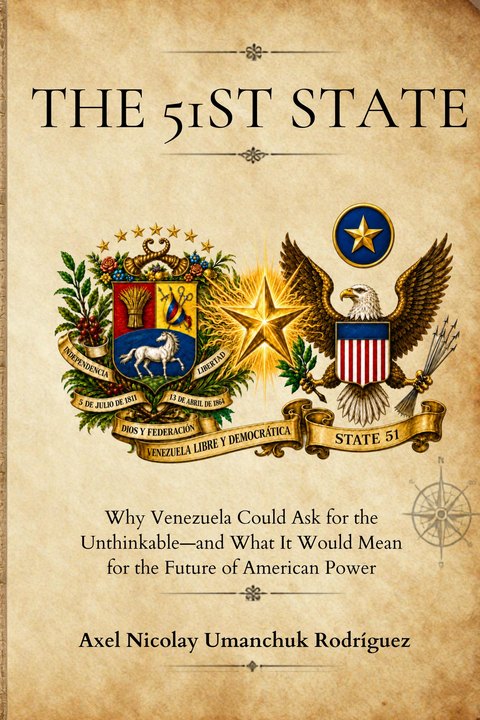
Cover of The 51st State: Why Venezuela Could Ask for the Unthinkable—and What It Would Mean for the Future of American Power
Go deeper · The 51st State series

The 51st State

Why Venezuela Could Ask for the Unthinkable — and What It Would Mean for the Future of American Power

The first volume poses the question seriously and maps the ground: the three paths, the yardstick by which each one is judged, and the thresholds that would have to be met. The other four volumes take up what is to be done next.

Also in Spanish: Estado 51 →
01Published
02In preparation
03In preparation
04In preparation
05In preparation